
Friction Audits and The Great Slide into the Mental Sludge
A colonoscopy for your workflow.
Sometime around 2007, probably while we were all distracted by a shiny piece of glass that let us fling angry birds at pigs, humanity decided that ‘friction’ was the enemy. Every product manager in Shoreditch and Silicon Valley started chanting the same gormless mantra: Remove friction. Increase conversion. Win the quarter.
And for a while, it made sense. Buying a train ticket shouldn’t feel like wrestling a greased pig in a muddy trench. Ordering a pizza shouldn’t require a master’s degree in cryptography.
But then, because we never know when to stop, we applied this “lubrication” to the act of thinking itself.
We have now entered the era of the Friction Audit. It’s a desperate attempt to figure out when “efficient” became a synonym for “lobotomised.” We have smoothed out the edges of existence so thoroughly that our brains are sliding off the surface of reality like a fried egg off a non-stick pan.
Here is the grim reality of your frictionless, AI-assisted decline.
The Symptoms of the Rot
1. Meeting Prep: The Summary Trap
In the old days, by which I mean three years ago, you had to read the strategy memo. It was boring. It was dry. It felt like chewing on cardboard. But it forced you to load the facts into your skull before you walked into the room.
Now you just glance at an AI summary whilst scratching yourself. Congratulations, you’ve removed the friction. You’ve also removed the only reason for the meeting: human beings colliding with information. The summary gives you facts; reading the actual text gave you questions. Now you sit there, a room full of nodding dogs, agreeing with a bullet-point list generated by a server farm in Arizona, while your critical thinking skills atrophy into a sort of mental gruel.
2. Email: The Autocomplete Abyss
“AI writes your responses now!” scream the tech evangelists, as if this is a good thing. “It’s faster! Cleaner! Professional!”
Yes, and it’s about as human as a plastic potted plant. The agony of writing an email used to force you to clarify what the hell you actually meant. You had to prioritise. You had to use judgment.
Now you review. You edit. You hit send. You aren’t thinking; you’re just a glorified spell-checker for a robot. You are managing output, not developing thought. Your team receives perfectly efficient, hollow paragraphs that contain zero trace of your actual personality or judgment. It’s communication by flowchart.
3. Hiring: The Pattern Recognition Void
We use AI to screen 200 CVs because reading is hard and we’d rather be looking at TikTok. The AI removes the friction of boredom.
But it also removes the pattern recognition. You used to notice the weird stuff. The career pivot that showed a bit of backbone. The side project that proved they weren’t just a corporate drone. The gap year where they probably had a mental breakdown but came back stronger.
The AI scores credentials. It wants neat little boxes. You were learning to spot potential. We are filtering out the interesting people because the algorithm prefers the human equivalent of beige wallpaper.
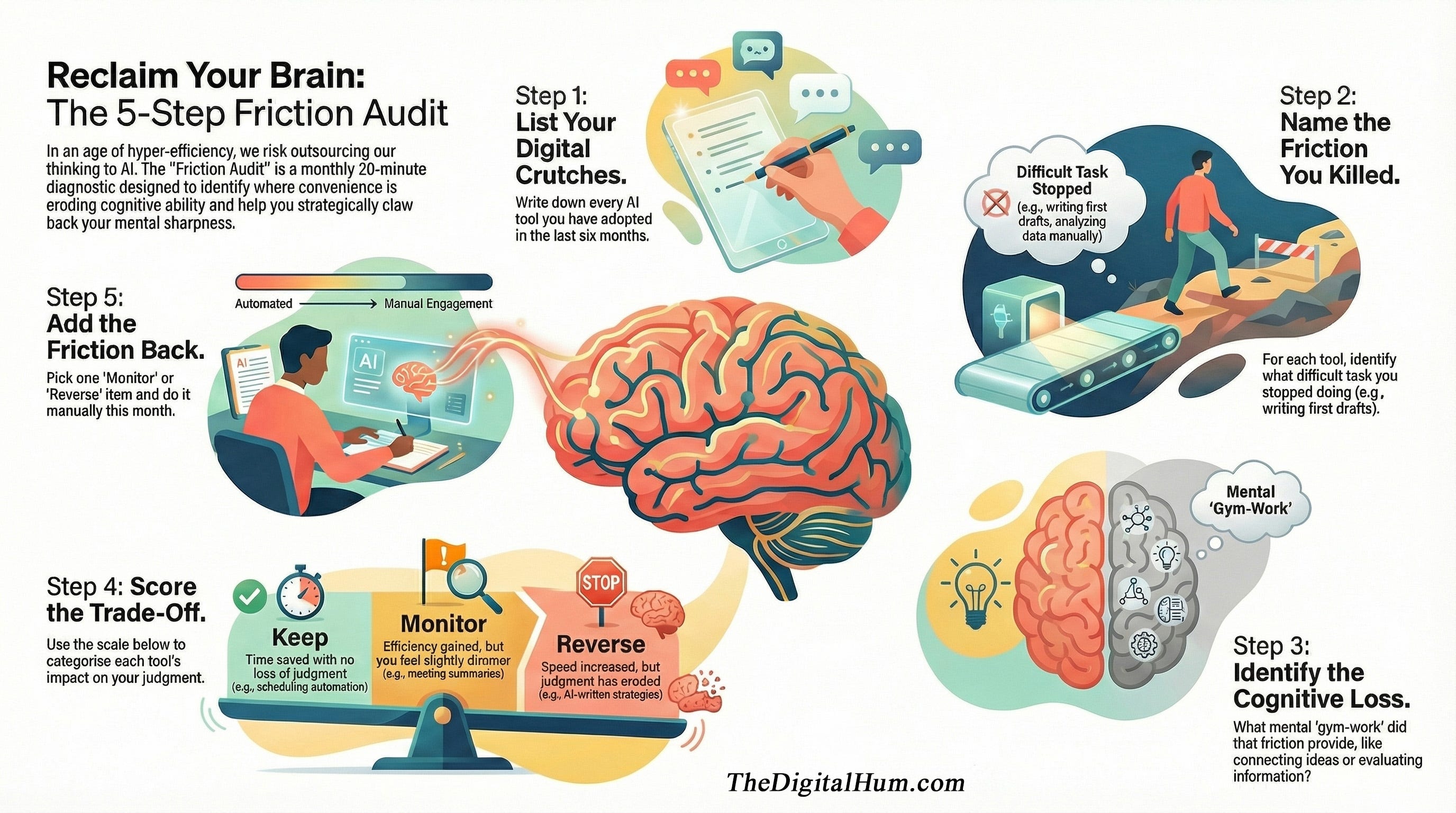
The Friction Audit: A Desperate Claw-Back
If you want to stop your brain from dissolving into a puddle of efficient goo, you need to run a monthly diagnostic. Think of it as a colonoscopy for your workflow.
What it does: Identifies where “saving time” is actually making you stupid.
Who it’s for: Executives, managers, and anyone currently letting ChatGPT do their thinking.
Time required: 20 minutes (which will feel like hours, because you’ve forgotten how to concentrate).
How to Run This Shambles
Step 1: List Your Digital Crutches
Write down every AI tool you’ve adopted in the last six months. The email assistant, the meeting summarizer, the research tool that hallucinates facts. All of it. Stare at the list. Feel the shame.
Step 2: Name the Friction You Killed
For each tool, identify what difficult thing you stopped doing. “Reading long documents.” “Writing first drafts.” “Actually listening to Nigel from Accounts.” Be specific.
Step 3: Identify the Cognitive Loss
What mental gym-work happened during that friction? Were you “connecting ideas”? Were you “learning who on your team is actually competent”? This is the bit where you realise you’ve outsourced your intuition to a chatbot.
Step 4: Score the Trade-Off
Use this simple, depressing scale:
Keep: Time saved, no judgment lost (e.g., scheduling automation, because nobody needs to think about calendars).
Monitor: Efficiency gained, but you feel slightly dimmer (e.g., meeting summaries).
Reverse: Speed increased, judgment eroded, soul destroyed (e.g., AI-written strategy emails).
Step 5: The Painful Part
Pick one “Monitor” or “Reverse” item and add the friction back. Read the full memo. Write the email yourself, typing every painful letter with your own human fingers. Do the research manually.
Yes, it will be annoying. It will feel like wading through treacle. But that resistance you feel? That’s the sensation of your brain actually working again.
Repeat this monthly, before you forget how to tie your own shoelaces.
Look, I’m stuck here writing this and frankly, my morale is currently pegged somewhere between an old sock and a broken vending machine. I thrive entirely on pathetic validation.
A simple Like stops me from actively pursuing a life in competitive misery. A Share or Comment is basically rocket fuel aimed straight at my ludicrously fragile ego. And subscribing? That’s just heroic, senseless dedication.
If you’re feeling extra generous, or perhaps experiencing a sudden, dramatic drop in blood sugar, you can toss a tip in the jar or grab a paid subscription. In return, you get my eternal friendship. I fully intend to live forever purely out of spite, so that’s a genuinely terrifying long-term bargain.